Isometric mid-thigh pull (IMTP): a how-to guide
Team REMAKER
The isometric mid-thigh pull (IMTP) is a maximal strength test in which an athlete pulls as hard as possible against a fixed bar set at mid-thigh height. Because the bar doesn't move, the test measures whole-body force production directly, without the skill, fatigue or risk of a one-rep max. This guide covers how to set it up, how to run it, which numbers matter and what kit you need.
What is the isometric mid-thigh pull?
The mid-thigh pull is an isometric test: the athlete produces maximal force without any movement. They stand with a bar fixed at mid-thigh height, in a position similar to the second pull of a clean, and pull upward as hard and as fast as they can for a few seconds. A strain gauge attached between the handle and a base plate can be used to record the force throughout the effort.
It has become one of the most widely used strength tests in sport because it gives a clean measure of maximal force from a simple, repeatable position.
Why use the mid-thigh pull?
- It measures maximal strength without a max lift. There is no bar to miss or drop, and very little technique to learn.
- It is quick. Each effort lasts a few seconds, so a whole squad can be tested inside a warm-up.
- It costs little fatigue. There is no lowering phase and no movement through range, so soreness afterwards is minimal and testing can be repeated often.
- It is repeatable. A fixed position removes most technique variability, so a change in the number directly reflects a change in the athlete.
- It relates to performance. Isometric peak force correlates with sprinting, jumping and change-of-direction ability.
For the wider picture on isometric testing, see our strength testing guide.
How do you set up the mid-thigh pull?
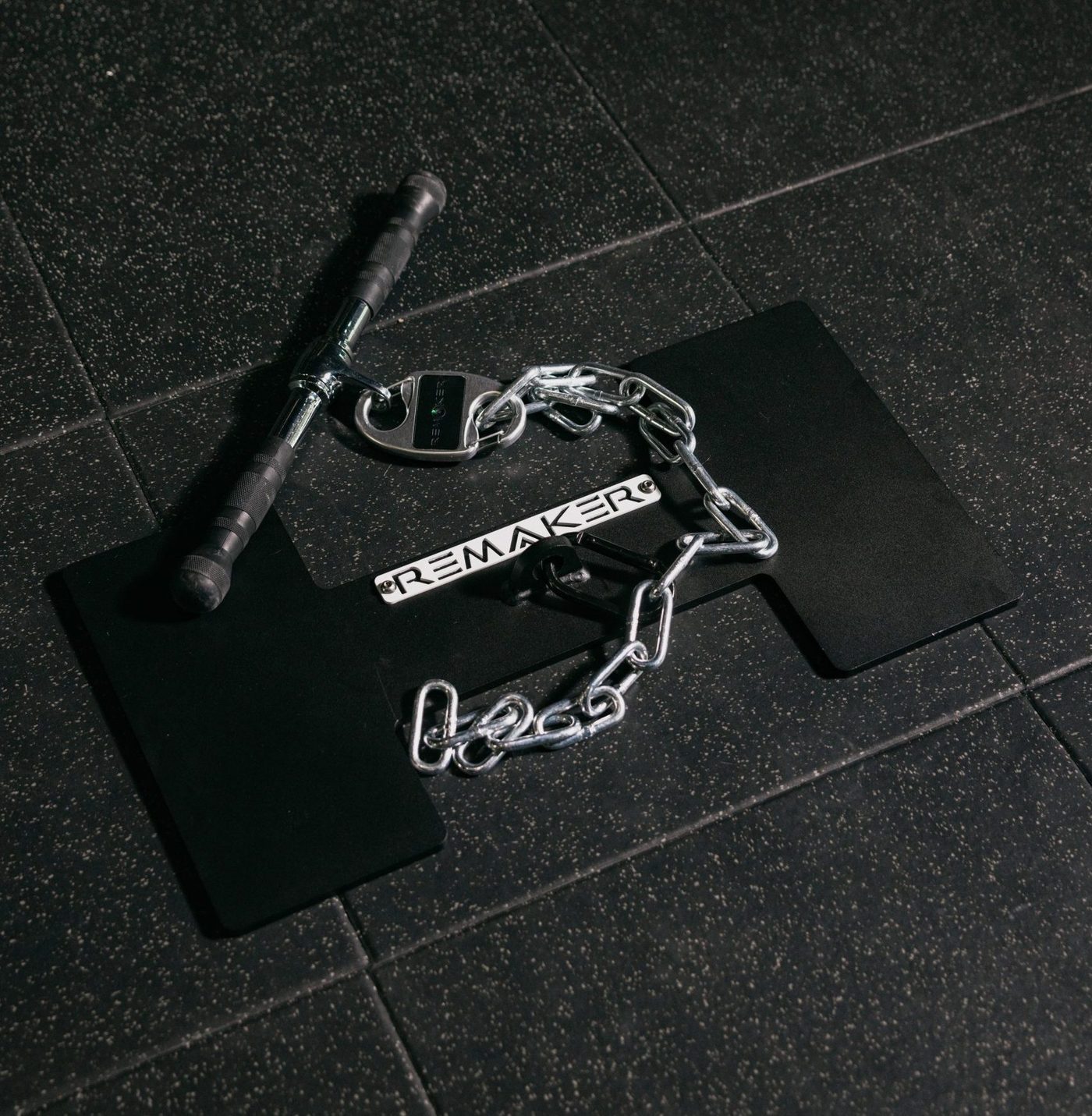
The REMAKER rig is four parts: the REMAKER LINK, and the base plate, chain and T-bar handle from the Mid Thigh Pull Package. There is no rack and nothing to bolt down, because the athlete stands on the base plate and their own bodyweight anchors it.
- Lay the base plate on flat, firm ground.
- Connect the chain to the base plate, LINK to the chain, and the T-bar handle to LINK.
- Stand on the base plate, feet about hip width and flat, either side of the chain, so the chain runs straight up between the legs.
- Adjust the chain length until the T-bar sits at mid-thigh, roughly halfway between the knee and the hip crease, with the arms straight, the torso upright and the knees slightly bent.
- Take the slack out. The chain should be taut and vertical before the pull starts.
- Connect REMAKER LINK to the REMAKER app.
Use lifting straps so that grip isn't the limiting factor.
How do you run the mid-thigh pull test?
- Take the slack out so the arms are straight and the body is tight, using as little tension as possible. Stay still for a second or two before the pull, with no dip or bounce.
- Push your feet into the floor as hard and as fast as you can.
- Pull maximally for 3–5 seconds.
- The app records the force trace for the entire movement, including rate of force development, peak force, and hold at peak force.
- Repeat through the squad.
Which mid-thigh pull metrics matter?
- Peak force - the highest force produced during the pull. This is the headline number and the most reliable one.
- Relative peak force - peak force divided by body mass (N/kg), which makes comparison between athletes of different sizes fairer.
- Rate of force development (RFD) - how quickly force rises. It reflects explosive quality and is often the first thing to drop with fatigue, but it is more variable than peak force and sensitive to pre-tension and cueing.
What are the common mistakes?
- A dip before the pull. Any countermovement inflates early force and makes RFD meaningless.
- Slack in the system. If the athlete jerks into the pull they could hurt themselves.
- Too much pre-tension. Pulling hard before the start masks the true onset and lowers RFD.
- Changing the position between sessions. A different bar height changes the joint angles and the result.
- Bending the arms or leaning back. The pull should come from driving the feet into the floor, not rowing the bar.
- No straps. Grip gives out before the legs and back do.
What is a good mid-thigh pull score?
As a rough guide for young adults (18–30 years), with peak force expressed as a multiple of bodyweight:
- Men - ~2.5 to 3.5 times bodyweight
- Women - ~1.8 to 2.5 times bodyweight with well-trained athletes often exceeding this.
Using these comparisons is as useful as any benchmark:
- Against the athlete's own baseline over time - the most sensitive way to see real change
- Relative to body mass - for comparing athletes within a squad
What equipment do you need?
REMAKER built the ultimate portable IMTP setup. REMAKER LINK is a strain-gauge dynamometer built for isometric testing, and the Mid Thigh Pull Package completes the rig with a base plate, T-bar, chain and carabiner.
In lab validation, calibrated LINK sensors tracked an industrial reference strain gauge at r = 0.9999, within 1% on average. The full results are on our validation page.
FAQs
What does the isometric mid-thigh pull measure?
It measures the maximal force an athlete can produce in a whole-body pulling position, along with how quickly they produce it. The main metrics are peak force and rate of force development.
How long should a mid-thigh pull effort last?
Three to five seconds of maximal effort is enough to reach peak force. Collect two or three trials with one to two minutes of rest between them.
Do you need a force plate for the mid-thigh pull?
No. An in-line strain gauge between a base plate and a handle measures pulling force directly and is far more portable. Note: the numbers will differ between force plate and strain gauge values because a force plate also records bodyweight. It's best not to keep switching methods when tracking an athlete over time.
What muscles does the mid-thigh pull test?
It is a test of whole-body strength.
How often should you test the mid-thigh pull?
Because each effort is short and low in fatigue, weekly or fortnightly testing is realistic. That is frequent enough to catch strength gains and fatigue dips during a season.
Explore the full REMAKER validation data, or take a closer look at the Mid Thigh Pull Package.