How to use isometrics to protect strength in-season
Team REMAKER
Reviewed by Dr Tom Samuel - Principal Clinical Lead at REMAKER
The in-season problem
In-season, your athletes are tired, sore and short on time. But strength doesn't wait for the off-season. Stop training it for eight weeks and it starts to leak away, along with the speed and robustness that depend on it.
So the question every coach faces is simple: how do you keep a high-quality strength stimulus without adding fatigue the athlete can't afford?
More and more coaches answer with isometrics. Not as a rehab-only tool, but as a deliberate in-season strength method. Here is what the research supports, what it doesn't, and how to measure it so you know it's working.
Two kinds of isometric
Coaches use two versions: overcoming isometrics, where the athlete drives maximally into something that won't move for around 3–5 seconds (an isometric mid-thigh pull or squat), and yielding isometrics, where they hold a submaximal load in position for longer (a weighted split-squat hold or Copenhagen hold). Our strength testing guide covers the definitions in more detail.
They feel similar, but they aren't the same. A 2024 review led by Dustin Oranchuk, with Danny Lum as co-author, found that the body appears to control holding and pushing differently. Holding seems to involve more complex control and more co-activation of surrounding muscles. As a result, choosing the right one for the job is important. Overcoming isometrics are more useful for maximal force and rate of force development. Use yielding for time under high tension, tendon loading and position control.
What the research says
1. A big strength stimulus for a small fatigue bill. Lum & Barbosa's 2019 review found that isometric training caused less fatigue than dynamic training. It produced better strength at the trained joint angle. It also carried over to running, jumping and cycling performance. That is exactly the trade-off you want in-season.
2. Gains are angle-specific, so pick the angle on purpose. Isometric strength improves most at the angle you train. Oranchuk and colleagues' 2019 systematic review of 26 studies also found that training at longer muscle lengths built more muscle. It also transferred better to dynamic performance than training at short lengths.
3. Tendons need heavy, sustained tension. The same review found that strength and muscle size improved at a wide range of intensities. Changing tendon structure and function needed high-intensity contractions, at or above 70% of maximum. In a classic study, Kubo et al. (2006) had people do isometric squats at 70% of maximum for 15-second sets, 4 days a week for 12 weeks. Stiffness of the tendon and aponeurosis in the knee extensors rose from 51 to 59 N/mm. That matters because a stiffer tendon passes force through faster. In Bojsen-Møller et al. (2005), tendon stiffness explained up to 30% of the variation in rate of torque development, and it correlated with jump height.
4. Intent changes the adaptation. Both reviews agree: perform isometrics ballistically, driving as hard and as fast as possible. That produces bigger improvements in rate of force development than a slow ramp to maximum. How you cue the rep decides what you get from it.
5. Isometrics aren't the whole answer. In the Kubo study, squat-jump height improved but countermovement-jump height did not. Isometric strength doesn't automatically become springy, fast stretch-shortening-cycle performance. Keep some fast, elastic work, such as low-volume plyometrics or sprinting, alongside it.
The coaching details that make or break it
The research gives you four dials. Most poor isometric training comes from leaving one of them on default.
| Dial | What to do | Why |
|---|---|---|
| Intent | Cue "as hard and as fast as possible" on overcoming reps | Ballistic intent drives bigger rate-of-force gains |
| Angle | Train the positions that matter in the sport, and favour longer muscle lengths | Gains are angle-specific; long lengths transfer better |
| Intensity | Use at least 70% of max on sustained holds when tendons are the target | Tendon adaptation needs high, sustained tension |
| Dose | Short maximal efforts (3–5 s) for force; longer holds (15–45 s) for tendon and position | Match the contraction to the quality you're building |
A cue that works: the UKSCA's IMTP methodology review recommends an external instruction to pull as hard and as fast as possible. It produced better outputs than an internal cue such as "contract your legs". Our mid-thigh pull guide walks through the full setup and protocol.
The coach's job here is consistency. If the angle drifts by 15° between sessions, or the cue changes, you aren't comparing like with like. Write the position down, and use the same setup and the same words every time.
How to measure it
Isometrics have one big weakness: nothing moves, so there's nothing to see. Bar speed can't tell you how hard an athlete pushed. Three numbers are worth tracking: peak force (your maximal strength marker), rate of force development (how quickly force rises, often more relevant to sport because most sporting actions are over in a fraction of a second) and impulse (force × time, showing how much force the athlete applied). See our strength testing guide for more on each.
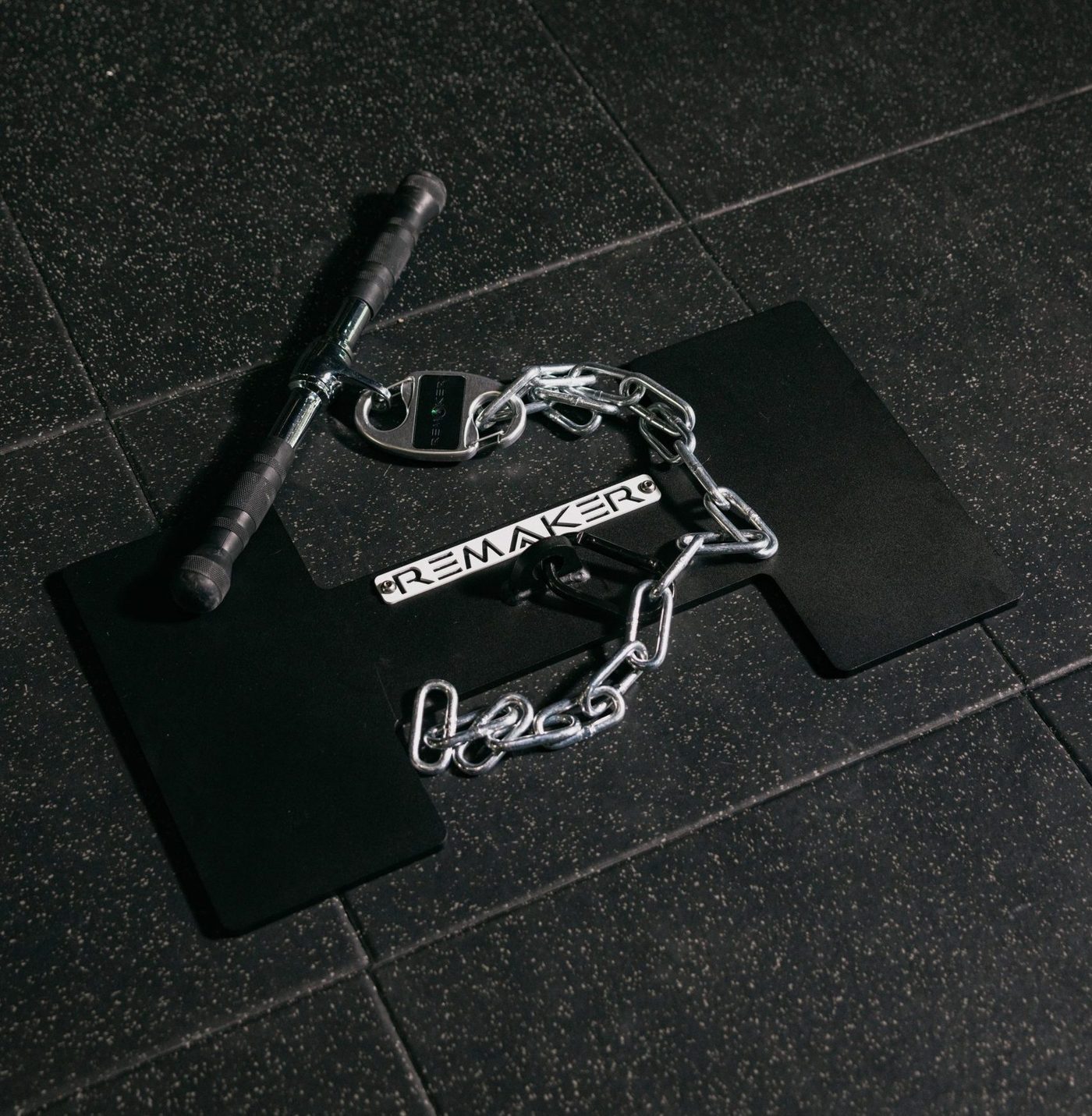
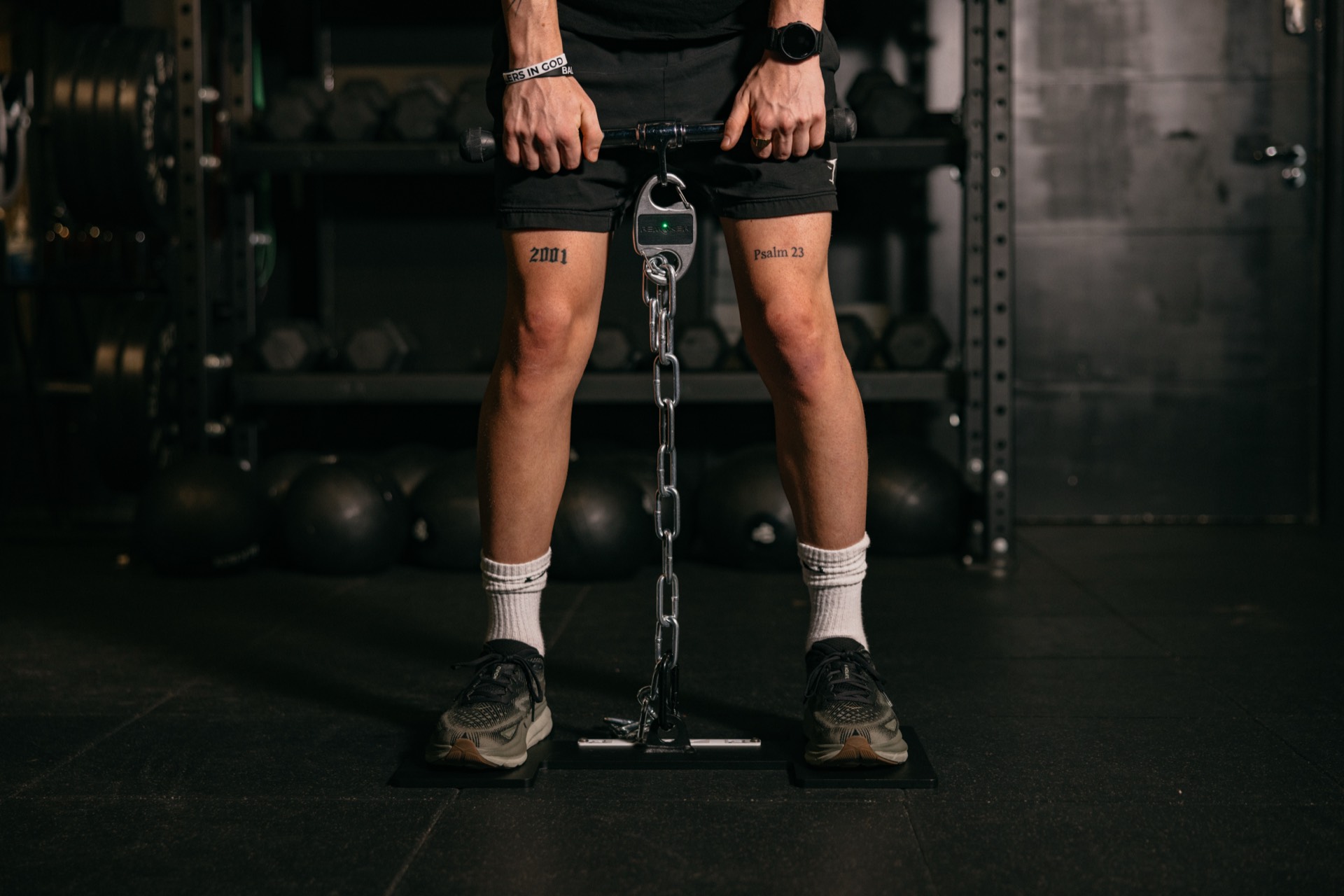
The REMAKER LINK tracks isometrics quickly and simply:
- Train and test at once. Each maximal rep gives you peak force and the shape of the force curve, so there's no separate test day eating into recovery.
- See the trend, not just the rep. A drop in peak force or RFD across a week is an early warning of fatigue. A steady line during a congested fixture block tells you strength is holding.
- Make feedback the motivation. Athletes push harder when they can see the number. That helps the ballistic intent the research says drives the adaptation.
- Take it where the athletes are. Test in the gym, at the training ground or pitchside, not just in a lab with force plates.
A simple in-season template
This is a starting point, not a prescription. Adjust it for the sport, the athlete and the fixture list.
When: 1–2 short sessions a week, placed away from the hardest training day and at least 48 hours before competition.
- Overcoming block (maximal force and RFD). Isometric mid-thigh pull or isometric squat at a sport-relevant angle. Do 3–5 reps of 3–5 seconds with full ballistic intent and 60–90 seconds' rest. Track peak force and RFD on every rep.
- Yielding block (tendon and position). Choose one lower-body hold, such as a split-squat hold at a long muscle length. Do 2–4 sets of 15–45 seconds at a load that feels heavy, at least 70% effort.
- Keep it springy. Add a small dose of fast, elastic work, such as a few low-contact jumps or short sprints. That way the stretch-shortening cycle doesn't go stale.
Using the data: take each athlete's best rep from the first week as their baseline. If peak force or RFD falls below the athlete's normal day-to-day variation for two sessions in a row, ask why. Look at sleep, minutes played, soreness and niggles, then adjust the load accordingly.
In-season training isn't about building new qualities. It's about protecting the ones you built, and spotting trouble before it shows up on the pitch. Isometrics, measured properly, do both.
References
- Lum D, Barbosa TM (2019). Brief review: effects of isometric strength training on strength and dynamic performance. Int J Sports Med 40(6): 363–375.
- Oranchuk DJ, Storey AG, Nelson AR, Cronin JB (2019). Isometric training and long-term adaptations: effects of muscle length, intensity, and intent. Scand J Med Sci Sports 29(4): 484–503.
- Oranchuk DJ, Nelson AR, Lum D et al. (2024, preprint). 'Pushing' versus 'holding' isometric muscle actions: a scoping and systematic review with meta-analyses. medRxiv.
- Kubo K, Yata H, Kanehisa H, Fukunaga T (2006). Effects of isometric squat training on the tendon stiffness and jump performance. Eur J Appl Physiol 96: 305–314.
- Bojsen-Møller J et al. (2005). Muscle performance during maximal isometric and dynamic contractions is influenced by the stiffness of the tendinous structures. J Appl Physiol 99(3): 986–994.
- Lum D, Haff GG, Barbosa TM (2020). The relationship between isometric force-time characteristics and dynamic performance: a systematic review. Sports 8(5): 63.
- Stone MH et al. (2019). Using the isometric mid-thigh pull in the monitoring of weightlifters: 25+ years of experience. Professional Strength & Conditioning 54.
- The isometric mid-thigh pull: a review and methodology, part 2 (2018). Professional Strength & Conditioning 51.
- Wang R et al. (2016). Isometric mid-thigh pull correlates with strength, sprint and agility performance in collegiate rugby union players. J Strength Cond Res. Summary.