What is reactive strength index (RSI)?
Team REMAKER
Reactive strength index (RSI) is a measure of how effectively an athlete turns a landing into a jump. It is calculated by dividing jump height by ground contact time, so a high score means getting a lot of height from very little time on the floor. This guide covers the formula, how to test it, what a good score looks like, and how to use it to guide plyometric and jump training.
What is reactive strength index?
RSI describes how much height an athlete gets for the time they spend on the ground:
RSI = jump height (m) ÷ ground contact time (s)
An athlete who rebounds 0.30 m with a ground contact of 0.20 s has an RSI of 1.5. Jump higher from the same contact time, or reach the same height from a shorter one, and the score goes up.
What it captures is the stretch-shortening cycle: the ability of muscle and tendon to absorb force on landing and return it immediately. That quality sits underneath sprinting, hopping, cutting and rebounding, where the foot is only on the ground for a fraction of a second.
One thing to check before comparing numbers: some systems calculate RSI as flight time ÷ contact time instead (often called the reactive strength ratio, or RSR). Both are valid, but they produce different numbers, so only compare scores calculated the same way.
Why does RSI matter?
- It reflects how athletes actually move. Most sporting actions happen on short ground contacts. RSI measures the quality that makes those contacts productive, which a maximal strength test alone doesn't show.
- It is quick to test. A few jumps in a warm-up is enough, with very little fatigue cost.
- It responds to fatigue. A meaningful drop against an athlete's own baseline is a useful flag that they are not fully recovered.
- It gives rehab an objective marker. Single-leg versions let you compare the injured side against the uninjured side as an athlete returns to running and jumping.
How do you test RSI?
Drop jump
Step (don't jump) off a box, land on both feet, and rebound as high as possible while spending as little time on the ground as possible. A 30 cm box is a common starting height. Keep hands on hips so arm swing doesn't change the result, and record three reps with full rest between them.
A cue that works well: treat the floor as if it's hot.
Pogo jumps (the 10-5 test)
Repeated stiff-legged jumps on the spot, bouncing mostly from the ankles. In the 10-5 repeated jump test the athlete performs ten consecutive jumps and the score is the average RSI of the best five. It needs no box, so it's the easiest RSI test to run in a warm-up or out on a pitch.
RSI-modified (countermovement jump)
RSI-modified swaps ground contact time for time to take-off in a countermovement jump (CMJ):
RSI-modified = jump height ÷ time to take-off
There is no landing before the jump, so it reflects a slower stretch-shortening cycle and gives much lower numbers. It's a useful metric in its own right, but it is not interchangeable with drop jump RSI.
What is a good RSI score?
For drop jumps, using jump height ÷ contact time, these bands are widely used as a rough coaching guide:
- Below 1 - reactive strength is still developing; build general strength and low-intensity plyometrics first
- 1 to 1.5 - moderate; ready for moderate-intensity plyometrics
- 1.5 to 1.9 - well developed
- 1.9 to 2.2 - high
- Above 2.2 - elite
Treat them as a guide, not a standard. Scores shift with box height and the RSI calculation used. The most useful comparison is always an athlete against their own baseline.
Check contact time alongside the score. A fast stretch-shortening cycle is generally defined as a ground contact under about 250 ms. If contacts are much longer than that, the athlete is absorbing the landing and jumping again, not rebounding, and the test is no longer measuring reactive strength.
What is plyometric training?
Plyometric training is jump, hop and bound work that trains the stretch-shortening cycle: a muscle is rapidly stretched on landing, then shortens immediately to produce more force than it could from a standing start. Plyometric exercises fall into two groups:
- Fast plyometrics (ground contact under about 250 ms) - pogo jumps, drop jumps, hurdle hops, bounding
- Slow plyometrics (longer contacts) - countermovement jumps, box jumps, squat jumps
Three principles cover most of the programming:
- Quality over quantity. Every contact should be a maximal, crisp effort. Keep sets short and rest fully between them.
- Progress intensity gradually. Start with low-impact work like pogos and skipping before moving to drop jumps from height.
- Build strength alongside it. Athletes need enough strength to control the landing before high-impact plyometrics are worthwhile.
How do you use RSI to guide plyometric training?
- Find the right drop height. Test drop jumps from several box heights (for example 20, 30, 40 and 50 cm). The height that produces the highest RSI is a sensible training height. Once RSI falls and contact time climbs, the box is too high for now.
- Check readiness. Run a quick pogo test in the warm-up. A clear drop from an athlete's normal range is a reason to pull back on high-intensity jumps that day. A 10-5 pogo test with REMAKER MOVE takes under a minute in the warm-up, and the app compares the result against the athlete's history to display readiness there and then.
- End sets on quality. With live feedback, stop the set when RSI drops away from the athlete's best efforts instead of chasing a fixed number of contacts.
- Track progress. Retest every few weeks under the same conditions. Rising RSI at the same box height shows the training is working.
How do you measure vertical jump height?
There are three common methods:
- Jump and reach. Mark standing reach against a wall or vane device, jump, and mark the highest touch. The difference is jump height. It's cheap and simple, but the result depends on reach technique and shoulder mobility.
- Flight time. Wearable sensors like the REMAKER MOVE measure take-off velocity and flight time and calculate jump height.
- Force plate. Calculates height from the force the athlete produces before take-off. These are expensive and not very portable.
Whichever method you use, standardise it: same warm-up, same arm position (hands on hips or free arm swing, not a mix), and the best of three attempts.
Which other jump tests are worth tracking?
- Countermovement jump (CMJ) - the standard test of lower-body power; track jump height over time.
- Squat jump - a jump from a paused squat with no dip. Comparing it against the CMJ shows how much an athlete gains from the stretch-shortening cycle.
- Single-leg jumps and hops - show left vs right differences, which matters most in rehab.
- Drop jump and pogo jumps - the RSI tests above.
Can you measure RSI without a force plate?
Yes - REMAKER MOVE is a wearable sensor that straps to the foot for jump testing and reports jump height, flight time and RSI in real time in the app. In validation against a force plate, MOVE's RSI correlated at r = 0.991 across 145 drop jumps and r = 0.995 across 367 pogo jumps, and countermovement jump height from 416 jumps came within 2.6% on average. In other words, the REMAKER MOVE provides lab-grade accuracy from a sensor that fits in your pocket. The full results are on our validation page.
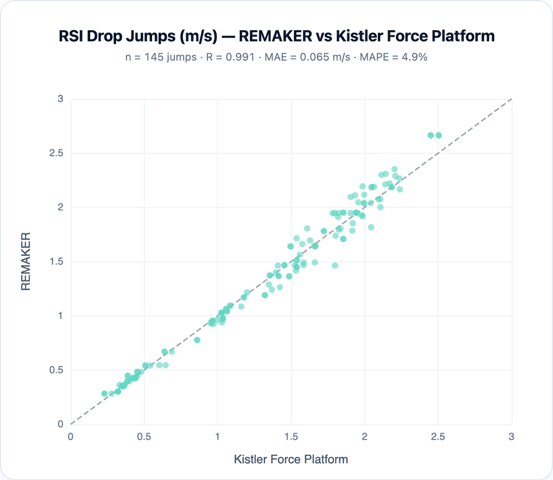 Drop jump RSI: REMAKER MOVE vs force plate, 145 jumps
FAQs
What is the formula for reactive strength index?
RSI = jump height (in metres) ÷ ground contact time (in seconds). A 0.30 m rebound from a 0.20 s ground contact gives an RSI of 1.5. Some systems use flight time ÷ contact time instead, which gives different numbers.
Is RSI the same as RSI-modified?
No. RSI comes from a rebound jump such as a drop jump or pogo and uses ground contact time. RSI-modified comes from a countermovement jump and uses time to take-off. The scores are not comparable with each other.
How often should you test RSI?
A set of pogo jumps or a few drop jumps takes under a minute and causes very little fatigue, so weekly testing is realistic. Test under the same conditions each time and compare against the athlete's own baseline.
Can you measure RSI without a force plate?
Yes. The REMAKER MOVE gives you RSI in real time when worn on the foot, using the REMAKER app.
Explore the full REMAKER validation data, or take a closer look at REMAKER MOVE.