The importance of neck training in sport
John Noonan
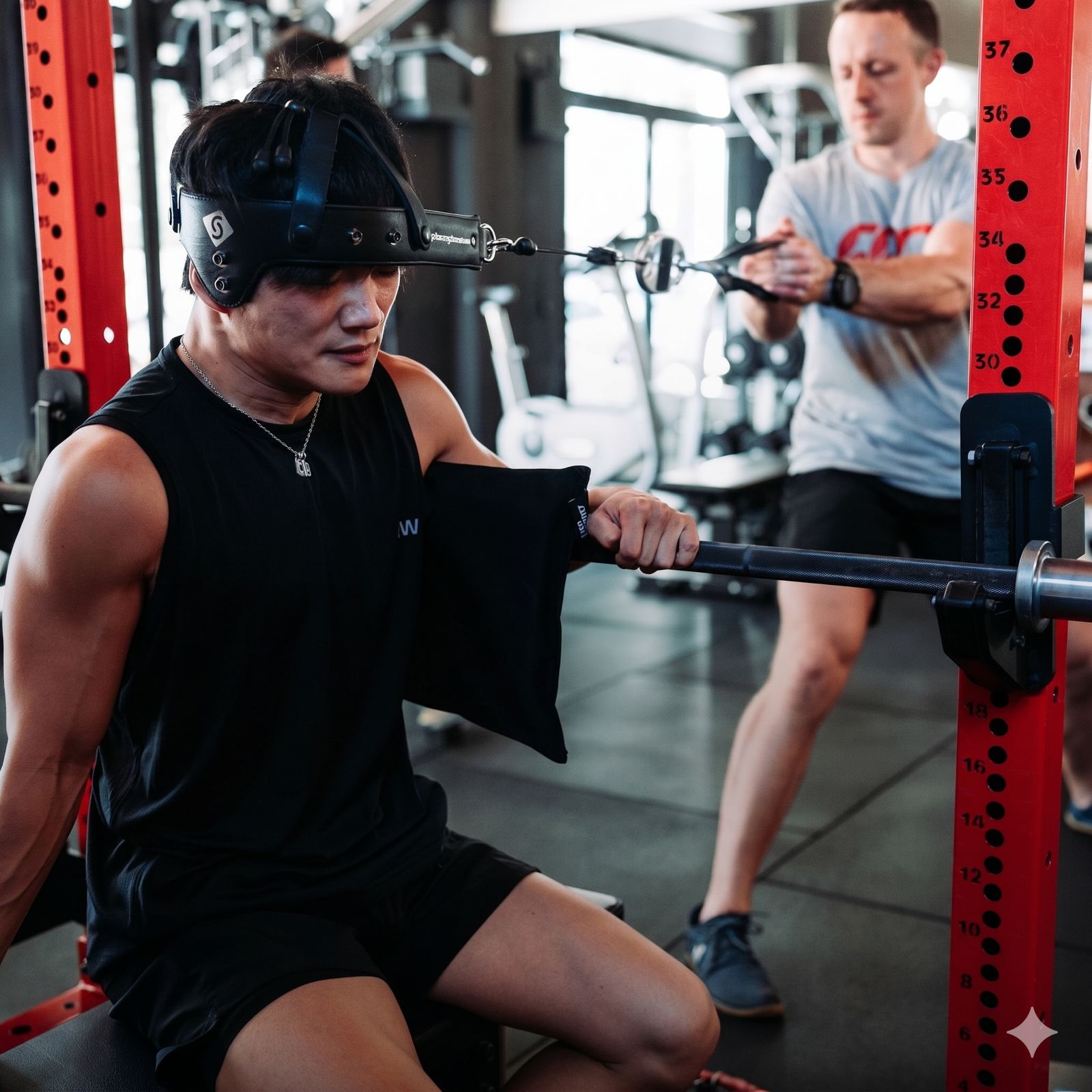
Ask most athletes which muscles they train and you'll hear about legs, backs, shoulders, and chests. Almost nobody mentions the neck. It sits at the top of the kinetic chain, carries the most important object you own, and in most training programs it gets nothing at all.
That's a problem, and our recent webinar laid out exactly why. Remaker featured a conversation with John Noonan, a performance coach whose career spans professional football, rugby, GB Snowsport, and the last few years in Formula 1 with Red Bull Racing. His route into neck training came from watching the athletes around him get hurt, and realising the gym work they were doing did nothing to protect the one area taking the heaviest hits. Here's the case he made:
 John Noonan — performance coach across professional football, rugby, GB Snowsport and Formula 1
The injury problem is bigger than people realise
A sport-related concussion is a form of mild traumatic brain injury caused by biomechanical forces to the head. It's most common in collision and impact sports, and over the last decade its prevalence has climbed sharply, partly because we're finally getting better at recognising and reporting it.
The scale is sobering. One widely cited paper from 2011 recorded around 225,000 new cases a year, a figure that at the time was comparable to the combined annual diagnoses of breast cancer, multiple sclerosis, and traumatic spinal cord injuries. England Rugby's own injury surveillance has tracked concussion incidence rising significantly from the early 2000s to today. In a recent season, professional international players lost an average of 18 days per concussion, and that's the optimistic end. The literature talks about a 7 to 10 day minimum, but it climbs to 20, 30, or 40 days once you factor in previous or successive episodes.
And it rarely travels alone. As John put it, concussion almost always arrives with some degree of cervical-spine injury. In MMA, where head impact is one of the leading injury mechanisms, the neck accounts for roughly 23% of the total injury burden. Whatever the sport, hurting the head and hurting the neck tend to happen together.
Why a prepared neck changes the outcome
The mechanism behind most of these injuries is a whiplash: an impact drives the head to the end of its range in flexion, then snaps it back into extension. At those extremes the soft tissue and ligaments are doing the work of decelerating the head, which is how you end up with lasting cervical damage alongside the concussion.
The timing is the brutal part. The soft-tissue structures around the head need at least 80 milliseconds to react to a force. A boxing impact peaks in 5 to 15 milliseconds. An American football collision lands in 10 to 30. In other words, the hit is over before the body's protective machinery can even respond. You cannot react your way out of that gap in the moment, which means the preparation has to be done long before, in training.
This is where the evidence for neck strength becomes hard to ignore. Across multiple studies, stronger necks resist sudden head movement, better tolerate both the linear and rotational accelerations that drive concussion, and distribute impact forces across larger structures instead of concentrating strain on vulnerable tissue. Research in rugby and American football has found that athletes with greater neck strength suffered fewer and less severe concussive impacts, simply because they kept better control of head position at the moment it mattered.
It doesn't replace good technique. The shift in rugby toward safer tackling is real and important. But the worst-case scenario never fully disappears, heads still find their way into bad positions, and a strong, well-controlled neck is what stands between an athlete and the consequences.
The motorsport side of John's work makes the performance case just as clearly. A driver's head and helmet weigh around 6.5 kg. Run that through a fast corner and the load multiplies fast: through the first corner at Suzuka you're looking at roughly 30 kg of force, and the worst-case values across a season push toward 35 to 45 kg, with crash loads exceeding 100 kg. Interestingly, collision sports expose the neck to peak loads many times higher than F1, but racing's signature challenge is that the effort is sustained. A driver holds those contractions for one corner, repeated across more than fifty laps, for an hour or more in the car. The neck is never off.
And the payoff for managing all that load is sharper performance, not just survival. The more stably you control your head, the clearer and steadier your vision, and the better you read braking markers, apexes, and gaps. There's a deep link between the neck and the visual and proprioceptive systems: the tissues of the neck feed the brain a constant stream of information about where the head is in space, which becomes the difference-maker when vision is challenged by vibration, fatigue, or a curb strike. Control the head, and you protect the one input the athlete relies on most.
Strength sets the ceiling
A tempting shortcut is to skip strength and just train endurance, on the logic that the loads in something like racing aren't maximal. John's answer is sharp: strength sets the ceiling, and everything else sits beneath it.
If one athlete is working at 40% of their maximum to meet a demand and another is working at 65% to meet the same one, the second fatigues faster, loses head control earlier, and gets more vulnerable exactly when it counts. Endurance without strength, as he puts it, just makes you very good at operating close to failure. Raising peak strength doesn't only buy you a higher ceiling; it raises endurance capacity too, so you fatigue less and hold quality output for longer.
This isn't just an elite-sport problem
Here's the part that should land for everyone, not just professional athletes. John pointed out that these structures are often tight, weak, and quietly overloaded by ordinary life: hours hunched over laptops and phones, day after day. The neck is under-prepared in most people long before any collision or corner enters the picture.
Whether you're a contact-sport athlete, a driver, or someone who simply wants to move and age well, the neck deserves the same deliberate, progressive training you'd give any other part of the body. It's been treated as an afterthought for far too long.
You can't train what you don't measure
The thread running through the whole session was that good neck training starts with assessment. You profile an athlete first, understand their strength, endurance, asymmetries, and flexor-to-extensor balance, and only then build a programme that targets the right qualities. Test through the season and you can prescribe loads precisely, track fatigue and readiness, and prove that the work is moving the needle.
That's exactly where REMAKER fits. The LINK sensor was John's go-to for neck testing on the road: a force transducer that gives clean, reliable, sensitive data, pairs with a harness for rotational loads, and is simple enough to use that you can have a real conversation with the athlete about their numbers there and then. Elite-level neck profiling, made practical and portable.
The neck protects your brain, holds your gaze steady, and sets the ceiling on how long you can perform. It's time we stopped leaving it out.
This article draws on REMAKER's neck training webinar with performance coach John Noonan. To explore REMAKER's neck strength and testing kit, get in touch with the team.